
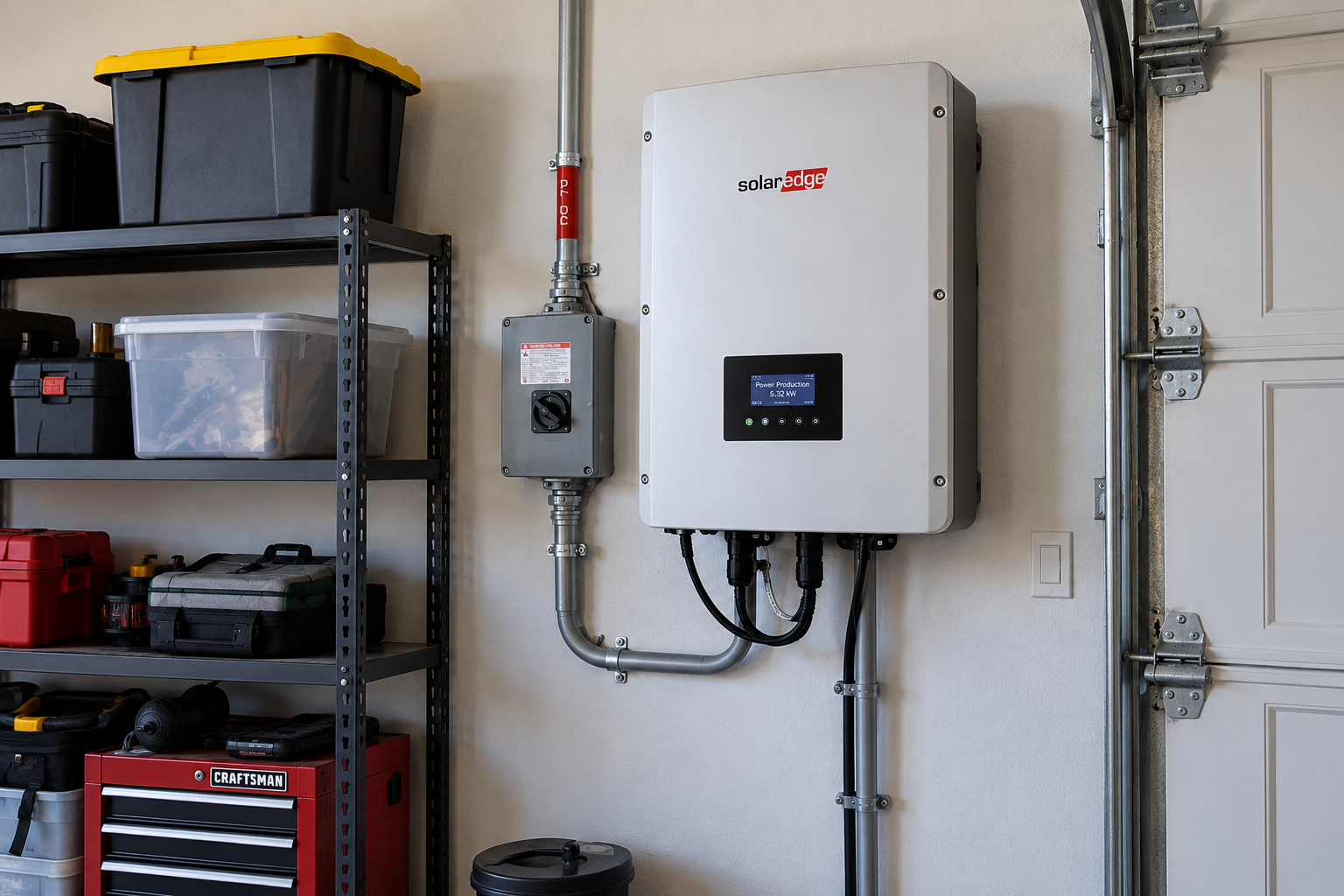
The main job of a solar inverter is to convert the DC electricity produced by your solar panels into AC electricity your home can use. Without one, well, your solar array is basically rendered useless. But as it turns out, these little boxes are quite the multitaskers. Depending on the type, an inverter can optimize energy production, monitor your system’s performance, and manage battery storage, among other functions. Read on as I walk you through what solar inverters do, how they work, and the different types you can choose from.
What Do Solar Inverters Do?
Convert DC Into AC
The primary job of a solar inverter is right there in its name: It inverts direct current (DC) electricity from your solar panels into alternating current (AC) electricity that your home can use.
It does so by using high-speed electronic switches to rapidly turn the direct current on and off, carefully controlling the timing and voltage to produce an alternating current that closely matches the electricity supplied by the utility grid.
Why the need for this translation? Because PV panels generate a type of electricity that is not compatible with what your household appliances use. Let me explain.
When sunlight hits the photovoltaic cells in your panels, it energizes electrons and creates an electrical current. That one-way flow of electricity is called direct current (DC).
Your home, however, runs on alternating current (AC), typically 120/240-volt AC service. That’s largely because the U.S. electrical grid has, for much of its history, been built around AC.
When the grid was first developed, AC could be transmitted over long distances much more efficiently and economically than DC by using transformers to step voltage up for transmission and back down before it reached homes.
Your solar inverter, then, acts as the “translator”, converting one form of electricity into the other so your appliances can use it.
Synchronize Your Solar System to the Grid
If you have a grid-tied solar system, your inverter does more than simply convert DC into AC. It also makes sure the electricity your system produces is compatible with the electrical grid, allowing any excess to be exported back to the utility.
This is what allows homeowners to participate in programs such as net metering or other utility export compensation programs, where available.
The inverter continuously monitors the grid and synchronizes its AC output so it matches the grid’s voltage, frequency, and phase.
If the grid goes down or falls outside acceptable operating limits, the inverter automatically stops exporting electricity to protect utility workers and the electrical system.
Optimize Solar Panel Output
At any given moment, every solar panel has a maximum power point – the combination of voltage and current that produces the greatest electrical output.
That optimum point isn’t fixed. It shifts throughout the day as sunlight intensity, cloud cover, and the panel’s temperature change. The ideal operating point under full midday sun may be different from what it was earlier that morning or during an overcast period.
Any deviation from that point results in lower power production. To prevent this from happening, the inverter continually adjusts the panel’s operating point through a function called Maximum Power Point Tracking (MPPT).
You can think of it like driving a car. Staying in the same gear all day wouldn’t be efficient since the ideal gear changes as your speed changes.
MPPT works similarly by “shifting gears” in real time. This way, the panels operate as close as possible to their maximum available power, even as conditions change throughout the day.
Monitor Energy Production
Modern solar inverters have come a long way. Many now connect to a mobile app or online monitoring platform that lets homeowners view their current power output, daily and monthly energy production, and historical system performance.
If your solar system uses microinverters or power optimizers, you may even be able to monitor production at the individual panel level.
Being the central monitoring hub also comes with another feature: fault detection. A sudden drop in energy production, communication issues, or electrical faults may trigger an alert or error code, helping identify potential problems much earlier than they might otherwise be noticed.
For solar professionals like us, this makes troubleshooting much more efficient since we can often narrow down the issue before arriving on site.
The 2026 International Photovoltaic Power Generation and Smart Energy Conference & Exhibition (SNEC 2026), one of the world’s largest solar exhibitions, offered a glimpse into where solar technology – including inverters – is headed.
AI applications showcased at the event included yield forecasting, predictive maintenance, defect detection, and other operations and maintenance (O&M) tools that could help solar professionals identify and address issues more proactively.
Manage Solar Batteries and Backup Power
Once backup storage is plugged into the equation, the inverter takes on another important responsibility: directing solar energy according to your energy priorities.
For example, if your system is configured primarily for self-consumption, the inverter first supplies your home’s electricity needs before directing any surplus toward charging the battery.
If it’s configured for battery-first operation, the inverter prioritizes charging the battery. Likewise, under time-of-use settings, it can charge or discharge the battery at different times of the day to help reduce electricity costs.
Different Types of Solar Inverters
String Inverters
A string inverter is a type of solar inverter that receives electricity from multiple solar panels wired together in series. The electricity produced by that single “string” flows as DC to the inverter, where it’s then converted into AC for your home.
The simplicity of this setup makes it a great fit for homes with relatively simple roof layouts that receive consistent sunlight with little or no shading throughout the day. On a single-pitch roof, for instance, a single string is often all that’s needed.
Gable roofs are also well suited to string inverters. Depending on the size and layout of the system, installers may use separate strings for, say, the east- and west-facing roof planes. Modern string inverters often include two or more MPPT inputs, allowing each string to operate independently at its own maximum power point.
Pros:
- With just one inverter to maintain, servicing and troubleshooting are generally simpler than systems with electronics installed beneath every panel.
- Because the inverter is typically installed in an accessible location (often at ground level), routine maintenance and servicing are generally easier.
- It is typically the most affordable inverter setup among the different types.
Cons:
- Shading or mismatched performance within a string can reduce the overall energy production of that entire string.
- A problem with the inverter itself can affect production from every panel connected to it. In some cases, it can stop the entire system from generating electricity until the issue is resolved.
- Basic string inverter systems typically don’t offer panel-level monitoring or optimization.
String Inverters With Power Optimizers
Let’s get one thing straight first: power optimizers are not a type of inverter. They’re small pieces of module-level power electronics installed at each solar panel and used alongside a string inverter.
The addition of power optimizers allows you to manage and monitor each solar panel individually, rather than only at the string level as with a traditional string inverter.
Each optimizer continually adjusts the voltage and current of its individual panel to help it operate closer to its maximum power point.
That means if one panel, for whatever reason, is underperforming, the other panels can continue operating closer to their own maximum power points rather than being dragged down to the same degree.
That being said, this setup is better suited to roofs where individual panels may receive different amounts of sunlight due to multiple roof slopes, nearby trees, chimneys, or other obstructions.
Pros:
- Provides panel-level optimization while retaining a central string inverter.
- Panel-level monitoring can make it easier to identify an underperforming or faulty module.
Cons:
- Adding an optimizer to every panel means more electronic components on the roof compared with a basic string inverter system.
- The additional hardware generally makes the system more expensive.
- While the optimizers can manage individual panels, the system still relies on the central inverter for DC-to-AC conversion. If that inverter fails, production from the connected strings can stop.
Microinverters
A microinverter is a small solar inverter installed underneath each individual solar panel. Therefore, the conversion from DC to AC electricity happens right at the panel.
Microinverters offer many of the same benefits as a string inverter–power optimizer duo, such as panel-level optimization and monitoring.
The biggest difference is that there is no single central inverter responsible for converting the output of the entire array.
If one microinverter goes down, the rest of the panels can continue generating electricity. That’s a huge advantage over a string inverter and power optimizer setup, where a failure of the central inverter can take the entire array connected to it offline.
Pros:
- Suited to roofs with complex layouts where panels receive different amounts of sunlight.
- Lets you monitor the performance of individual panels, making it easier to spot one that’s underperforming.
- There’s no single central inverter whose failure can stop DC-to-AC conversion for the entire array. If one microinverter fails, the other panels can continue producing electricity.
Cons:
- Installing microinverters across the array means more equipment and generally a higher upfront cost than a basic string inverter system.
- Servicing can be more involved since replacing a failed unit typically requires removing or lifting a panel to reach it.
- Microinverter systems produce AC electricity at the array, so adding battery storage generally means using an AC-coupled storage architecture or other compatible equipment.
- Stops working in the event of an outage, unless your microinverters come with “grid-forming” technology capable of isolating your home from the grid.
Hybrid Inverters
A hybrid inverter is a solar inverter designed to manage electricity coming from your panels, battery, utility grid, and the electrical loads in your home.
If you open up a hybrid inverter, you’ll see it has all the makings of a typical string inverter, but with two important additions:
- DC battery charging: A hybrid inverter can direct DC electricity from your solar panels into a compatible battery without first converting it into AC. This avoids the additional DC-to-AC and AC-to-DC conversion steps associated with charging an AC-coupled battery from solar, reducing conversion losses along the way.
- Bidirectional battery conversion: The inverter can also pull DC electricity back out of the battery and convert it into AC electricity your home can use. That’s one up from a traditional solar-only string inverter, which is designed primarily to convert electricity coming from your solar panels.
All that said, you can pretty much think of a hybrid inverter as a string inverter with extra muscles.
Perhaps the biggest advantage comes during a power outage.
When paired with a compatible battery and the appropriate backup equipment, a hybrid inverter system can automatically isolate your home from the utility lines, create its own closed electrical loop, and allow your solar panels to continue generating electricity for your home.
A typical grid-tied string inverter can’t do this on its own. When the grid goes down, anti-islanding protection requires the solar system to stop energizing the utility lines for safety purposes. Otherwise, electricity from your panels could backfeed onto lines that utility workers may expect to be de-energized.
Pros:
- Combines solar and battery management into one integrated system.
- Gives you more control over when solar energy is stored, used, or exported to the grid.
- When paired with the appropriate backup equipment, it can keep all or part of your home powered during a grid outage.
Cons:
- Generally costs more than a basic grid-tied string inverter.
- Battery compatibility matters, so you can’t assume that any hybrid inverter will work with any home battery.
Central Inverters
Central inverters aren’t something you’d find in a residential solar installation, but they’re worth knowing about nonetheless.
You can think of a central inverter as a much larger, industrial-scale version of a string inverter. Many strings containing hundreds or even thousands of solar panels (such as those in solar farms) are combined and routed to one large, high-capacity inverter that converts their collective DC output into AC electricity.
These inverters can be large freestanding cabinets or equipment housed together on dedicated concrete pads or inverter stations.
Which Solar Inverter Is Worth It for Your Home?
As you can see from our discussion above, you’ve got quite a few options when it comes to solar inverters. The “right” one ultimately comes down to your priorities. Below are some guiding questions to ask yourself:
- Does your roof have a simple layout with little to no shade? If your panels will mostly face the same direction and receive similar amounts of sunlight, a traditional string inverter may be all you need.
- Does your roof experience partial shading or have panels facing different directions? Panel-level optimization from microinverters or power optimizers may be worth paying extra for.
- Do you want to monitor each solar panel individually? If so, you’ll want a system with microinverters or DC power optimizers paired with a compatible string inverter.
- Do you want to add a solar battery now or in the future? If battery storage is already part of the plan, a compatible hybrid inverter may make more sense.
- Do you want backup power during an outage? If backup power is important, a hybrid inverter paired with a compatible battery is usually the best fit.
You don’t have to figure all of this out on your own, though.
A solar professional can look at your priorities alongside the technical details of your property that may otherwise fly under your radar.
That includes how many solar panels can fit on your roof, panel orientation and tilt, your projected energy consumption, utility requirements, and whether your proposed system leaves room for adding more panels later on, among other considerations.
If you’re ready to go solar, Avail Solar can help you put together a system based on your home, energy needs, and priorities. We install residential solar systems throughout Salt Lake City and surrounding areas across Utah.
Request a free solar quote today or contact us to discuss what kind of system makes sense for your home.
FAQs
Can Solar Panels Work Without an Inverter?
Yes, solar panels can generate DC electricity without an inverter. However, they can’t be used to power household appliances that run on AC electricity. That’s why practically every residential solar system needs an inverter.
How Long Do Solar Inverters Last?
Solar inverters, particularly string inverters, generally last around 10 to 15 years. You may need to account for the possibility of replacing an inverter during the lifespan of your solar panels, which is typically around 25 years. Microinverters, on the other hand, tend to have life spans closer to that of the solar array itself.
How Much Does a Solar Inverter Cost?
A residential solar inverter typically costs between $1,000 and $3,000, although the final price depends on the inverter type and system size.
However, if you’re installing a new solar system, you won’t be paying for the inverter as a separate purchase. It’s usually included as part of the total solar installation package alongside your panels, mounting equipment, electrical work, permits, and labor.